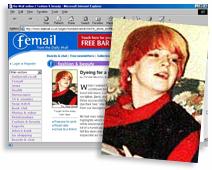
 Dyeing For A
Change Dyeing For A
Change When I walked
through the door aged 14 with cornflower blue
hair, my mother, Barbara, burst into tears. I
came from a respectable family, my father, Beric,
was a joinery manufacturer with three successful
factories. 'Only common people dye their hair,'
she cried, 'it's not something people from our
background do.'
My hair was
naturally very thick and black with red
highlights which would catch in the sunlight. But
while everyone else seemed to love it, I found it
a bit of a handicap. I was only 4ft tall at the
time, and felt the dark colour made me look even
shorter especially as I had pale skin.
I'd seen,
from visits to the hairdresser, that you could
dye your hair every colour under the sun. At 14,
I felt strong enough to deal with the inevitable
reactions to being different.
Dyeing my
hair blue was a way of letting everyone know that
I would never be the 'Laura Ashley', middleclass
person they all wanted me to be. I had rebelled,
and I found the whole experience very
liberating.
And I know
I'm not alone. According to a new survey, seven
out of ten women have dyed or highlighted their
hair all their adult lives.
The
psychology of changing your hair to be different
or to feel better is why so many women do it. It
has allowed me to be distinctive and different -
to feel sexy and good about myself.
Although I
did it to break the rules, some do it to signal a
new start. That is proven time and time again
when women change their hairstyle after breaking
up with a partner.
I got a
hell of a lot of stick for the way I looked.
Taxis and buses refused to stop for me, and I was
constantly on the receiving end of comments such
as: 'I didn't know there were clowns in town.'
But instead of making me feel more fragile, it
made me stronger and more determined to be what I
wanted to be.
When my
career as a singer took off in the 1980s, I moved
to London and as I was becoming famous, I was
lucky enough to get it done for free. My hair,
which had been the bane of my mother's life when
I was younger, was now making me a fashion
icon.
Even though
I'd been dyeing my hair for more than ten years,
I had no side-effects whatsoever. Yet there was
one occasion when it went wrong.
For some
reason I didn't go to my normal hairdresser, and
they let an apprentice loose on my hair. I wanted
to have it dyed jet black with lots of pillar-box
red streaks. It was all going well until she
tried to bleach the black strands. Apparently the
black dye is even more aggressive than bleach, so
my hair went to powder.
After years
of going to the hairdresser trying outlandish
hairdos, I knew it was going to happen but the
apprentice ignored me. In the end they had to cut
the whole lot off, which didn't look too bad, but
I never went back there again.
Throughout
the 80s I continued to get my hair dyed bright
primary colours every few weeks, but in 1993 I
decided enough was enough.
Like many
women, I found my hair colour was dictated by my
career and my age. Margaret Thatcher famously
advised us to go lighter as we get older. I was
turning my hand to TV presenting, and decided to
change peacock vibrancy for blonde
elegance.
Blondes may
have more fun, but my main reason for going
blonde was professional. The brightness of the
colour reflects off the skin and makes you look
younger.
Being
blonde has helped me understand why so many
millions of women have done it - I've got more
work out of it and had more fun. Fortunately, no
man has treated me like a idiot - they wouldn't
dare.
So am I
going to keep dyeing my hair? Of course I am.
After all, there's precious little else you can
change without going under the knife.
Daily
Mail
28th
August 2003
|