 How Green Is My Valley? How Green Is My Valley? Very green,
if you happen to live in the Vale of Conwy. It's
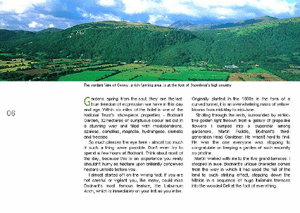
a verdant swathe of farmland and forest
stretching from the coast of the foothills of
Snowdonia. Not only that, but along the way
there's Bondant, one of Britain's finest gardens.
Toyah Willcox, an enthusiast of all things green,
takes a look:
Katharine
Hepburn once said to me that Wales was the most
beautiful place on Earth. She was referring to
North Wales - Snowdonia to be precise. According
to the brochures, it's a 'land carved by glaciers
and bathed in mystery, so much so it will draw
you back time and time again'. Well it has only
taken me 26 years to return, but I have been
somewhat busy. If I'm not on stage, on the TV or
writing a book I'm probably starving in the
depths of the Australian jungle or trying to get
the tea stains off my best porcelain mugs. I
don't know how I do it but I always manage to
forget to have holidays.
Now
I am winding down the A470 from the coast towards
Betws-y-Coed. It may sound romantic and believe
me, it is! I am on my way through the Vale of
Conwy and thinking I should have come back
sooner.
I
have the grand boast of being able to say I spent
two months in Betws-y-Coed in 1978 making a film
with the late, legendary Katharine Hepburn and
director George Cukor. We were filming a remake
of Emlyn William's The Corn Is Green, a Welsh
classic. Most of our time was spent waiting for
the rain to thin and the fighter jets from some
nearby air base to stop 'buzzing' us. but that
said, the warmth of the people and the magnitude
of the natural beauty left an indelible and
delectable mark on my memory.
 Now I'm pulling into the
drive of Tan-y-Foel Country House (the English
pronounce it 'ton of oil') after a pleasant and
not too long journey from London. Now I'm pulling into the
drive of Tan-y-Foel Country House (the English
pronounce it 'ton of oil') after a pleasant and
not too long journey from London.
On
first appearances it looks like a small,
well-maintained guest house, albeit one with
magnificent views over Snowdonia. Then I step
through the front door and am blown away.
Tan-y-Foel is a little gem.
Take
the snappy modernism of London's Soho House and
the grandeur of Bath's Ston Easton Park, remove
the stuffiness and pomp of both and condense them
into a six-bedroom private country house and you
have Tan-y-Foel. The locals call it the 'posh
Japanes place on the hill'. I call it 'yummy'.
It's clean, crisp, friendly, incredibly relaxing
and plainly adored by the Pitman family 'mother',
father and daughter' who created it and run it
personally.
I
arrived with the world on my shoulders, worrying
about misplaced e-mails, VAT accounts and a
leaking immersion tank. Within five minutes the
lot was forgotten. My only criticism was that my
room was so comfortable (four-poster bed, large
batheroom, etc, etc) that I could easily have
stayed put and not walked a single hill.
Next
morning I was greeted by the view over the rocky
peaks of Snowdonia that gives Scotland,
Switzerland or France a run for their money. But
I wasn't here to climb mountains but to look at
something a little less wild. Beneath me lay a
beautiful, broad vale carved by the River Conwy.
It was a garden in itself, with neat fields and
rivermeadows flanked by hills and forests. My
destination, however, was the genuine
article.
 Gardens spring from the
soul, they are the last true freedom of
expression we have in this day and age. Within
six miles of the hotel is one the National
Trust's showpiece properties - Bodnant gardens,
32 hectares of sumptuous colour laid out in a
stunning way and filled with rhododendrons,
azaleas, camelias, magnolia, hydrangeas, clematis
and freesias. Gardens spring from the
soul, they are the last true freedom of
expression we have in this day and age. Within
six miles of the hotel is one the National
Trust's showpiece properties - Bodnant gardens,
32 hectares of sumptuous colour laid out in a
stunning way and filled with rhododendrons,
azaleas, camelias, magnolia, hydrangeas, clematis
and freesias.
So
much pleases the eye here - almost too much if
such a thing were possible. Don't even try to
spend a few hours at Bodnant. Think about most of
the day, because this is an experience you really
shouldn't hurry as hectare upon brilliantly
conceived hectare unfolds before you.
I
almost started off on the wrong foot, if you are
not careful or vigilant you, like many, could
miss Bodnant's most famous feature, the Laburnum
Arch, which is immediately on your left as you
enter. Originally planted in the 1880's in the
form of a curved tunnel, it is an overwhelming
mass of yellow blooms from mid-May to
mid-June.
Strolling
through the arch, surrounded by reflective golden
light thrown from a galaxy of grape-like flowers
I bumped into a superstar among gardeners, Martin
Puddle, Bodnant's third-generation Head Gardener.
He wasn't hard to find. He was the one everyone
was stopping to congratulate on keeping a garden
of such enormity so pristine.
Martin
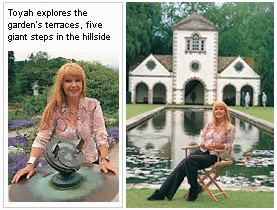
walked with me to the five grand terraces. I
stopped in awe. Bodnant's unique character comes
from the way in which it has used the fall of the
land to such striking effect, stepping down the
hillside in a sequence of huge Italianate
terraces into the wooded Dell at the front of
everything.
Ahead
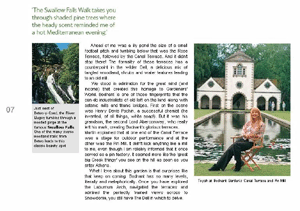
of me was a lily pond the size of a small
football pitch and tumbling below that was the
Rose Terrace, followed by the Canal Terrace. And
it didn't stop there! The formality of these
terraces has a counterpint in the Winter Dell, a
delicious mix of tangled woodland, shrubs and
water features leading to an old mill.
 We stood in admiration for
the great mind (and income) that created this
homage to Gardener's World. Bodnant is one of
those fingerprints that the can-do industrialists
of old left on the land along with satanic mills
and titanic bridges. First on the scene was Henry
Davis Pochin, a successful chemist (he invented,
of all things, white soap!). But it was his
grandson, the second Lord Aberconway, who really
left his mark, creating Bodnant's glorious
terraces. We stood in admiration for
the great mind (and income) that created this
homage to Gardener's World. Bodnant is one of
those fingerprints that the can-do industrialists
of old left on the land along with satanic mills
and titanic bridges. First on the scene was Henry
Davis Pochin, a successful chemist (he invented,
of all things, white soap!). But it was his
grandson, the second Lord Aberconway, who really
left his mark, creating Bodnant's glorious
terraces.
Martin
explained that at one end of the Canal Terrace
was a stage for outdoor performances and at the
other was the Pin Mill. It didn't look anything
like a mill to me, even though I am reliably
informed that it once served as a pin factory. It
seemed more like the 'great big Greek thingy' you
see on the hill as soon as you enter
Athens.
What
I love about this garden is that surprises like
that keep on coming. Bodnant has so many levels,
literally and metaphorically. Once you have
explored the Laburnum Arch, navigated the
terraces and admired the perfectly framed views
across to Snowdonia, you still have The Dell in
which to delve.
On
the descent I discovered a magnolia (Magnolia
Wilsoni) growing low enough to the ground for my
short little legs to reach a bloom and sniff. It
has the most extraordinary fragrance of passion
fruit and vanilla. And, providing yet another
contrast, in The Dell I had to peer skywards to
see the top of the largest giant redwood (Sequoia
sempervirens) in Britain, one of the many
magnificent specimens of 200-year-old native and
introduced trees.
After
the splendour and the crowds - for Bodnant is
incredibly popular - I headed back into the Vale
of Conwy. gardens and gardening are a passion in
these parts. I'd been told about the small, neat
village of Rowen, just across the valley. Every
two years, the villagers open up their gardens to
visitors and hill walkers. Although this won't be
happening again until 2006, it's worth a visit at
any time. Rowen, the complete opposite to the
lavish wealth of Bodnant, is brimming with
affordable inspiration and ideas. It's a rare
sight in modern Britain to see such an unspoilt,
timeless village. there's even a fabulously,
uncrowded tea room - a huge welcome after the
queues st Bodnant - called Pen-y-Bont where you
can nourish yourself with everything from chicken
breast in wine to home-made lemon sponge. And
it's cheap but delicious!
Even
though I had by now been thoroughly spoilt by the
vale I always like to save the best till last. I
have such vivid memories of filming in
Betws-y-Coed I couldn't wait to return to see if
it had changed in the 26 years since I was last
there.
In
many ways it hadn't. The hotel I had stayed at
looked exactly the same. But further up into the
town, I couldn't believe the number of shops -
many, many of them, selling outdoor gear to
crafts. I suppose this is no bad thing since when
I was last here it was nearly impossible to feed
yourself past sunset. But, one thing, I'm pleased
to report, hasn't changed - those magical
walks.
Good
walking routes sprout in every direction from the
centre of town. I chose the Swallow Falls Walk. I
was on my own but still felt very safe. In this
area there's a huge love of the outdoors, so
wherever you venture you bump into like-minded
people.
The
Swallow Falls Walk takes you through shaded pine
trees where the heady scent reminded me of a hot
Mediterranean evening. I was there in the height
of summer and the famous falls were what I would
call friendly, trickling and welcoming, but I'm
sure that after a serious rainfall the whole
experience would change dramatically. As the sun
started to fade this was a moment of bliss. It
allowed me to visit old territory in my memories;
of Katharine Hepburn chatting with the locals,
completely under their spell; of the film crew
lugging huge lights up the hillsides to shoot the
night shots; of the phone calls to the Ministry
of Defence asking them to re-route the fighter
jets.
But
my most enduring memory was of sitting in a field
with Miss Hepburn talking about glamorous
Hollywood and at the sam time thinking to myself,
'nothing compares with this'.
The
article also includes a substantial 'travelfile',
with details on how visitors can experience
everything Toyah did.
A
View of Wales
Spring/Summer 2005
|