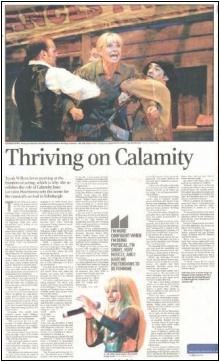
 Thriving
On Calamity Thriving
On Calamity Toyah
Willcox loves pushing at the frontiers of acting,
which is why she so relishes the role of Calamity
Jane. Lorraine Mawhinney sets the scene for the
musical's arrival in Edinburgh.
Toyah
Willcox is everything you expect her to be, but
still manages to confound all expectations. In
her Basingstoke dressing room, costumes for her
role as Aladdin await the next of that week's 12
performances; but hanging at the mirror is the
mystical Egyptian ankh and other accessories more
telling of her rebellious roots.
When she
arrives, thrusting a mug of tea forward, "I
wasn't sure if you take milk", her tiny
frame seems to fill the entire doorway and the
room springs to life.
This is the
person to have round for those "can't be
bothered" moments.
This panto
run of two shows a day, six days a week for four
weeks she calls a "holiday" from the
touring production of Calamity Jane.
"We
were touring Calamity for three months doing
eight shows a week. I had a week off and into
this. Then I have another week off and it's back
into Calamity Jane." There's a look of sheer
delight when she talks about this workload,
particularly the prospect of getting back into
buckskins.
"I
love Calamity Jane. I love it to death. When I
was approached to play it last year I had to say
yes, but with the rider that I couldn't go down
the same road as Doris Day. I mean, come on . . .
"But
this production has a beautiful, no-nonsense
approach. There's no glitter, no camp dance
steps, and it's back to the nitty gritty. It's
intended to be a little more historically
accurate. We've forgotten about technology and
gone back to how humans would have behaved being
stuck in this desert town."
Certainly,
they would have behaved pretty badly. Willcox
becomes even more animated when talking about the
real Calamity.
"Did
you know she was a real person? A really dubious
background, too. She was an occasional
prostitute, but then again, I think most people
were then.
She was an
Indian scout for the army, though." Fans of
the Doris Day/Howard Keel love match may wish to
look away now.
"She
never got together romantically with Bill - there
were questions about her sexuality - but it seems
that she may have had a child by him.
"She
did join his wild west show, though, and it seems
she died of alcoholism after touring
Europe." Audiences in 1953 would have choked
on their popcorn if Doris had chosen to go down
this route, but for Willcox her Calamity has to
be slightly more spit and sawdust.
One thing
it does have in common is the physicality. Doris
Day was injured on the set while being thrown
around the saloon by Howard Keel. After watching
rehearsals, Toyah's lawyers insisted she made a
will.
"I get
caught, I get thrown. Things get really rough.
Then I get hoisted up on to rafters." The
fact that all this is said with an ear-to-ear
grin leads you to suspect that this is what
attracts her to the role.
"Well,
I presume that my Calamity is chaste, so all that
pent-up energy goes into aggression and
physicality." Physicality is a word that
comes up with alarming regularity.
"I
love throwing myself into things. I'm a huge fan
of Theatre de Complicite. They haven't asked me
to join, although I've done the workshops.
"I'm
well aware that I'm not a typical female heroine.
I can't just stand there and open my mouth, my
voice isn't velvety enough for that, so I've
always over-compensated.
"I'm
more confident when I'm being physical. I'm
short, very muscly, and I have no pretensions to
be feminine." This does seem strange as
Toyah is more conventionally pretty than at any
other time in her career.
"Well,
I haven't cut my hair for two years. I didn't
want to wear a wig and we had to think of a way
that Wild Bill could see Calamity as a real woman
for the first time. When I tear the ballgown off,
I stand there semi-nude.
My hair has
fallen down and tumbled down over my shoulders. I
think long hair tumbling down like that will
always be a turn-on." Her single-minded
approach to work seems to be an antidote to
depression which is alluded to.
"Work
keeps me physically and mentally fit. I think
most artists have a tendency to depression and
extreme physicality is how I deal with it. Even
when I'm working I end every day with an hour of
aerobics.
"I'm
44 now and loving my forties. My thirties were a
different matter - the most miserable time of my
life. I was going through changes, I got very
overweight and I didn't have any kind of
spiritual base. I really felt I was never going
to fight back."
The
importance of conventional beauty in showbusiness
is something that Willcox returns to and names
actors such as Billie Whitelaw and Judi Dench as
inspiration. "When I was a pop star I didn't
think beyond 30. In the area I was working in, it
seems that you're written off after about 25. I
also know that at my age, I'm seen as difficult
to cast."
But one way
or another Toyah Willcox has survived and
thrived, probably in areas that hardened fans of
her early albums are appalled by, but still,
she's working while contemporaries are nothing
more than TOTP2 fodder.
Many of her
contemporaries, however, are still working and
still relevant. Siouxsie Sioux, Kate Bush, Debbie
Harry were all women who inspired a generation of
teenage girls with more than platform soles,
branded lollipops, and girl-power soundbites.
"I
think at the time people like us were still
struggling in a real male area. I think we had
work to do: the women of the 1960s, I feel, were
exploited by the sexual revolution.
"I do
think that people who liked me really suffered
for it. Everything I did came from inside my head
in a darkened room, so I probably attracted
like-minded folk, whereas someone like Kate (who
is Toyah's best friend) was very good at
researching her music and lyrics." Apart
from theatre, there has been TV acting and
presenting.
"I
think I'm still working because of my personal
approach. I'm pretty fascistic in my work and I
think that reputation spreads.
"I
like to be off script at first day of rehearsal,
I love the tradition of theatre and like to be
silent on the wings. I do sell my soul while I'm
working.
"TV is
fine. It gets you into living rooms and it
reminds people you're still there, but theatre is
by far the most satisfying. It's the only job
where I can go home at night and feel truly
satisfied. Nothing else does that for
me."
Not even
live music. Despite an enjoyable Here and Now
eighties tour, live music performance is
nerve-racking.
"With
live music you have to be yourself, and I don't
like that. I've always been very nervous with
that and I always will. I reason I love doing
something like Calamity is I know that everything
I'm good at, I can put into the character.
"Music
is forced torture for me. Oh my god, I shouldn't
say that, I can see the headline now 'Torture
that cuts both ways'."
The demands
of an extensive theatre tour (and the possibility
of a west end run) mean that there's little time
to return home to Worcester and husband Robert
Fripp.
While any
marriage between Toyah and the King Crimson
guitar guru would hardly be conventional, she
admits that their nomadic lifestyles mean they
rarely see one another.
"I
don't get home much, but I don't want to. We are
both very much travellers. He was here last week
and I'll see him again soon, but we're happy that
way.
"He
has a new King Crimson album out in March and
he'll be away promoting that. Actually, there's a
great buzz about it. They're saying it's the best
in 20 years. Even I like it."
There are
more conventional aspects to the relationship,
however. When they're invited to parties, there's
always a note at the bottom saying "bring
your guitar" and Fripp spends time with the
in-laws when Toyah is away.
"Where
we live in Worcester, we're right on the Avon so
my parents can reach us quickly by boat. We see
as much of them as possible. Robert lost his
parents about 10 years ago, so mine have really
taken him under their wing.
"If I
phone and I can't get hold of Robert I phone my
dad's mobile and find out that they're off to a
museum or the cinema or something." One
thing the parents can forget about is any
Willcox/Fripp collaborations.
"I've
never wanted children, but what I'm realising now
is there's something in the genetic structure
that I nickname the death gene. I think I have
inherited a gene somewhere that tells me that
this is where this line ends.
My sister's
the same. She's 54 and has no interest in
children.
"Robert's
take on it is that by stopping the family line,
you free yourself from the earthly plain. Your
spirit has evolved enough and you can go straight
to Nirvana. But that's the Buddhist take on it. I
just have no maternal instincts."
There's a
pattern of contradictions with Toyah.
Contradictions or keeping her options open.
Whichever, it seems to be the smart move.
No maternal
instincts, but great success voicing the
Teletubbies and playing a ghost in the children's
show Barmy Aunt Boomerang for BBC Scotland.
Despite
management pressure, she's also fighting to keep
panto as part of her schedule, too.
She sees
organised religion as highly political but has
fronted Songs of Praise and the Heaven and Earth
Show.
She's also
launching herself back into torture again with
new music. The Little Tears of Love EP will be
released around May, or when she has time to
promote it.
"2003
is actually my 25th year in the business, so
there will be one big concert and a mini-tour.
But it all depends what happens with Calamity
Jane.
"I
think I spent far too much time wanting to be
famous. Now that I can enjoy the work. I feel
real joy again."
Calamity
Jane is at the King's in Glasgow from January 21
for a week and the Festival Theatre in Edinburgh
for a week from January 28.
Glasgow
Herald
7th
January 2003
Thanks
to Alec Kelly
|